Showing posts with label Hypericum kalmianum. Show all posts

Saturday, August 6, 2011

Glass Half Full

It is on days like this I remember why I chose the name for my blog. It has continued to be really hot, and really dry. Each morning the weather lady tells me that the heat advisory includes my county, and that the chance for shower relief is 20%. Each afternoon the field turns another notch towards the right on the green to brown color continuum. Each night I fall into bed exhausted, having done little actual work besides watering and weeding.
 While wandering around the nursery trying to figure out where to start today, I am also reminded that there are a really good handful of plants that actually like this hot dry weather (besides crabgrass, that is....) So today I am applauding these durable woodies which perform in spite of my negligence. Let's take a look:
Rosmarinus 'Anna Hulke'
 Rosemary is a no-brainer. And comes in many sizes, forms, and textures. This picture is of a large sturdy shrub form called Anna Hulke. I don't do anything to it, but this big upright takes pruning very easily, and could be a very formal hedge. As far as I know, nothing can kill it.....maybe the combination of bad drainage and irrigation.
Abelia 'Rose Creek' and Lantana 'Apricot Sunrise'
Lantanas and Margarita

 Nothing in the summer really beats
Lantana.
There are many coming on the market that are cold hardier than they used to be, and can now be considered perennial in many areas. In addition to profuse flowering in a wide range of colors and habits, these plants are deer proof, and maintenance free. That's my kind of plant!
Buddleia x 'Silver Anniversary'
Anisacanthus wrighti
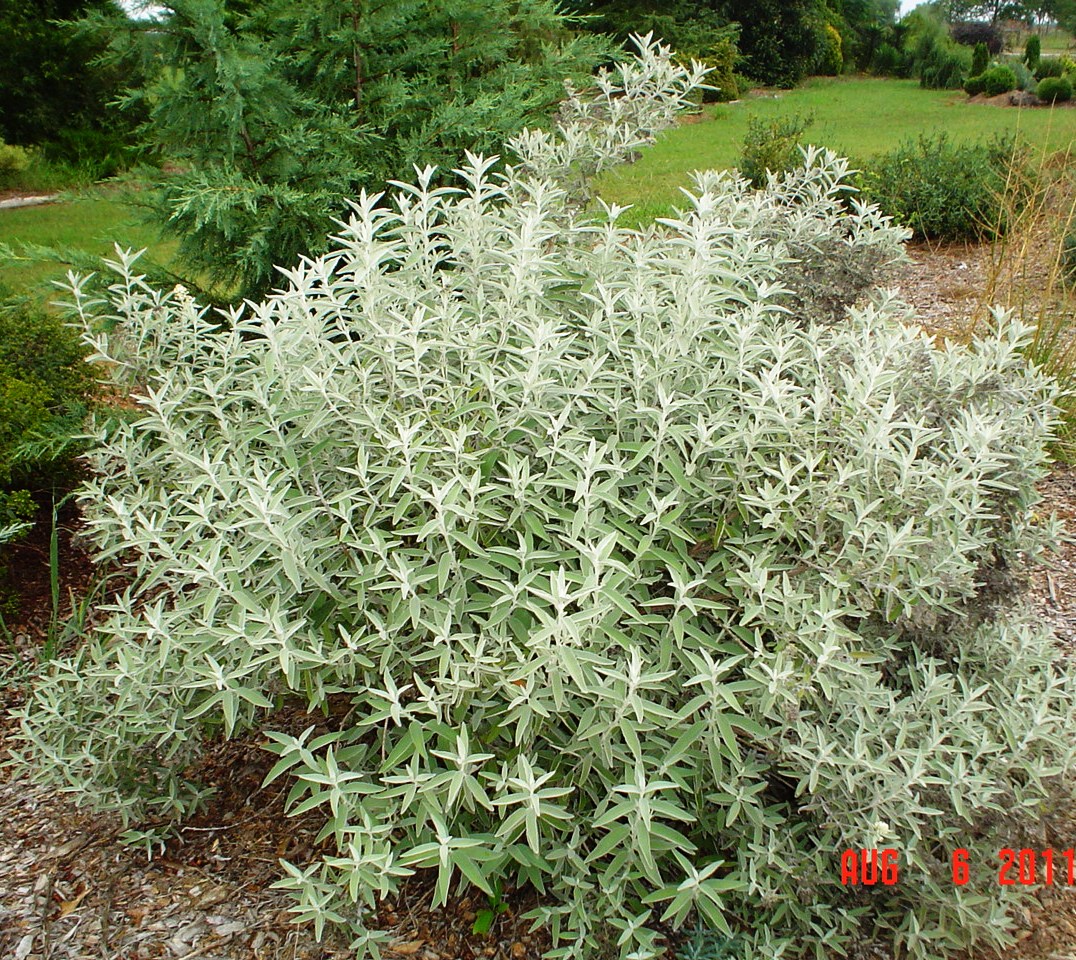
A couple of easy, tough shrubs are Buddleia "Silver Anniversary' and Anisacanthus wrightii. Each of these loves hot weather, grows to about 3'x3', and they are also deerproof.
Caryopteris 'Longwood Blue'
 Another group of plants that are a joy in mid to late summer are Caryopteris (Blue Mist Shrub) There's 'Longwood Blue', Summer Sorbet', Worchester Gold' and 'Snow fairy' just to name a very few. Deer Proof, tough, and a bumble bee magnet!
Caryopteris 'Snow Fairy'
Caryopteris 'Worchester Gold'
Cupressu glabra 'Chapparal' behind Caryopteris 'Summer Sorbet'
Here's a photo of an old fashioned southern
garden plant : Cestrum parqui. It blooms from about May thru till frost. We usually prefer botanical names, but this plant is often referred to as the "peanut butter plant" because of that distinct foliage smell.
Cestrum parqui
Another very aromatic plant that shines in the heat is this green santolina. It will make a fantastic dark green mound that will not melt out no matter how hot or dry it gets.
Santolina virens
Another great group of plants that I like more and more each day is the shrub Hypericums. They are evergreen, deer proof, heat and drought tolerant. They have large starburst yellow flowers in mid summer, and maintain a nice neat habit of about 3-4' x3-4' with absolutely no maintenance. These are not easily found in the retail market, but certainly should be. Go look for them in gardens around your area.
Hypericum densiflorum

Hypericum pseudohenryi
Hypericum kalmianum

 I will throw a few plant combos in here. I am sure there are many possibilities, but these turned up in my early August garden as examples: From herbaceous perennials to evergreen shrubs to magnificent large conifers, there are many plants that can spice up your summer garden. Now is the time to find them, take note, and make plans to put them in your garden as soon as it cools off and starts raining again. "For myself I am an optimist – it does not seem to be much use being anything else "- Sir Winston Churchill
Agave, Euphorbia, Juniperus deppeana
Amsonia hubrechtii and Colocasia 'Black Magic'


Conifer display
Opuntia and Artemisia

Monday, May 31, 2010

Spring's Successes


We've just finished up another spring season. I'd have to say that I was pleased with the spring, and have been reviewing some of the best of it.
Perhaps the best of the spring propagation was the first time germination of seed from the Euscaphis japonica. It was 18 or so years ago, on a visit to the NC State Arboretum, that JC Raulston gave me a handful of seed from this very special tree at the Arboretum. The tree was a seedling from seed he had collected on Paengnyong Island off the N. Korean coast in an expedition to Korea with Barry Yinger. JC's own notes:

"9511 Euscaphis japonica (Thunb.) Kantiz - "Euscaphis" (Staphylaceae). A deciduous tree to 30' from Japan, China and Korea of great beauty with multi-season interest. The compound foliage is glossy and handsome all summer; fruiting panicles up to a foot in diameter are produced with red fleshy pulp highlighted by shiny black seeds that are showy for 3-4 months in late summer and fall, and in the winter the bark is deep purple with white striping. They have grown well in our poorly drained clay nursery field and seem extremely stress tolerant. Cuttings can be rooted from softwood growth but have proven hard to keep alive through the first winter. Ample seed is now being produced by trees in The NCSU Arboretum (now the JC Raulston Arboretum) nursery. They seem to have double dormancy - requiring a cold period, followed by a warm period, and a second cold period before germinating in high percentages. We have also had more than average difficulty in transplanting and establishing young seedlings - with a very high damping off rate on seedling transplants. The plants are spectacularly beautiful and have commercial potential - but it will take time to develop seed blocks, and master the varied cultural requirements to get the crop to market. Likely adaptable for use in USDA Zones 6-9. Our best plants are unfortunately in the field nursery out of public view, and unfortunately the plant in the east arboretum (Hamamelis collection area near the Crepe Myrtles) is not as showy in fruit as many are. If one is visiting Wilmington, it is worth a trip to the New Hanover County Arboretum to see their very fine plants in the fall."


Of the handful of these gift seed, two germinated. One of them now grows happily at Specialty Ornamentals. I have collected and sowed Euscaphis seed from this tree for at least the last ten years without one successful seedling. This year's collected seed were sowed in fall, and germinated seemingly all together in late February. Today, after one transplanting, there are perhaps 100 seedlings doing very well and growing on. It is noteworthy that I finished reading the biography of JC Raulston Chlorophyll in his Veins by Bobby Ward in early February. Coincidence? Certainly. But a very sweet reminder of a wonderful man who was a gift to the world of horticulture. His legacy lives on in all of us, and now, happily, his Sweetheart Tree lives on here. (http://www.ces.ncsu.edu/depts/hort/consumer/factsheets/trees-new/euscaphis_japonica.html)

I've been particularly happy with the performance of some of the Hypericums I've been growing. They were great when we had total drought. But after the year of rain, I wondered how they would do. Two of the best are H. kalmianum
and H. pseudohenryi.

Hypericum kalmianum is native to the upper midwest, but grows easily from zones 4-7. It has lovely bluegreen evergreen foliage, flowers profusely, and makes a lovely low border shrub that looks good in masses. Sun to part shade and relatively poor soil tolerance also makes it a good choice for foundation planting.


Hypericum pseudohenryi is a native of China, has deep green evergreen foliage and masses of bright yellow sunburst flowers. In addition to the green foliage of the warm season, the foliage in fall has a magnificent crimson that holds thru the winter. It is every bit as tough and tolerant as kalmianum. Both species, in fact all species of Hypericum, are deer proof.


And speaking of deer.....The rain this winter made all the oakleaf hydrangeas absolutely lush and loaded with flowers. Hydrangea quercifolia 'Harmony' and 'Amethyst' are both fabulous selections. 'Harmony' has a flower that is extra fat and full. Hydrangea quercifolia 'Amethyst' seems like it might be your standard oakleaf panicle.....until it turns an amazing crimson and holds that color till November!


 But my favorite by far is Hydrangea quercifolia 'Snowflake'- the double hose-in-hose flower that keeps unfolding one inner flower after another. Below is my beautiful stand of 'Snowflake' before ......here are my gorgeous flowers after the deer made a tapas evening out of them.

As Confucius said...... "When prosperity comes, do not use all of it"

This spring, the deer have made sure of that.